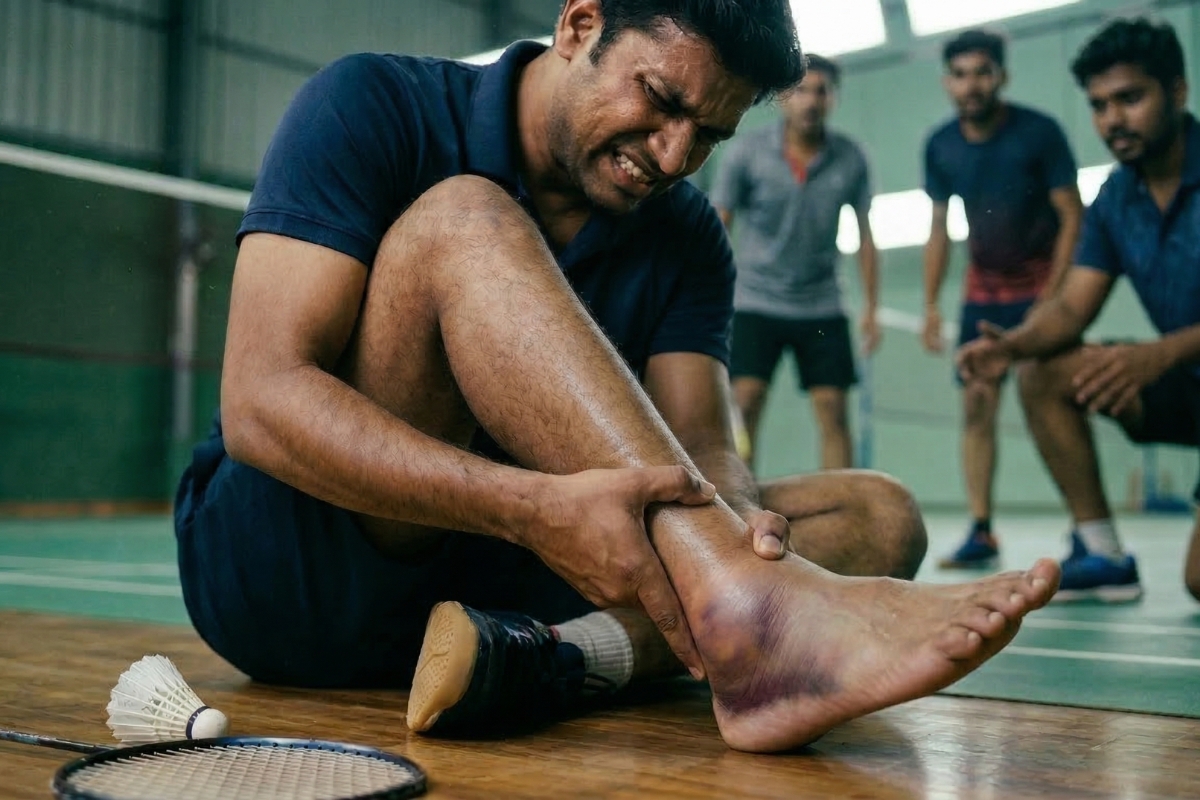
An ankle sprain is not always a minor twist that settles in a few days. Without proper rehabilitation, some patients go on to develop recurrent sprains or chronic ankle instability. Understanding what is injured and following the right recovery steps makes a real difference to long term ankle function.
I twisted my ankle. What is actually injured?
The ankle is stabilised by strong bands of tissue called ligaments. When the foot rolls inward suddenly, which is the most common mechanism, the ligaments on the outer side of the ankle are stretched or partially torn. This is called a lateral ankle sprain.
The most commonly injured ligament is the anterior talofibular ligament, often shortened to ATFL. It runs from the outer ankle bone toward the front of the foot. In more significant sprains, the calcaneofibular ligament, or CFL, may also be involved.
A ligament injury does not always mean a fracture. Most ankle sprains involve no bone damage at all. However, certain findings on examination make an X ray necessary to be certain. The Ottawa Ankle Rules below help clarify this.
How it usually happens here
Weekend cricket and badminton
Landing from a jump or changing direction quickly on a badminton court, or twisting the ankle while fielding or running between wickets during cricket, are frequent causes we see in Ambattur and Avadi.
Staircase misstep
Missing a step while coming down stairs, particularly in dim light or while carrying something, is one of the most common everyday causes. The ankle rolls suddenly and the outer ligaments take the full force.
Uneven ground and kerb edges
Walking on uneven road surfaces, stepping off a kerb unexpectedly, or misjudging a footpath edge on an evening walk are common outdoor triggers in Thirumullaivoyal and surrounding areas.
Wet tiles and monsoon conditions
Wet bathroom tiles, rain slicked temple steps, and damp entrance floors during the monsoon season can cause a sudden loss of grip and ankle roll.
Grades of ankle sprain
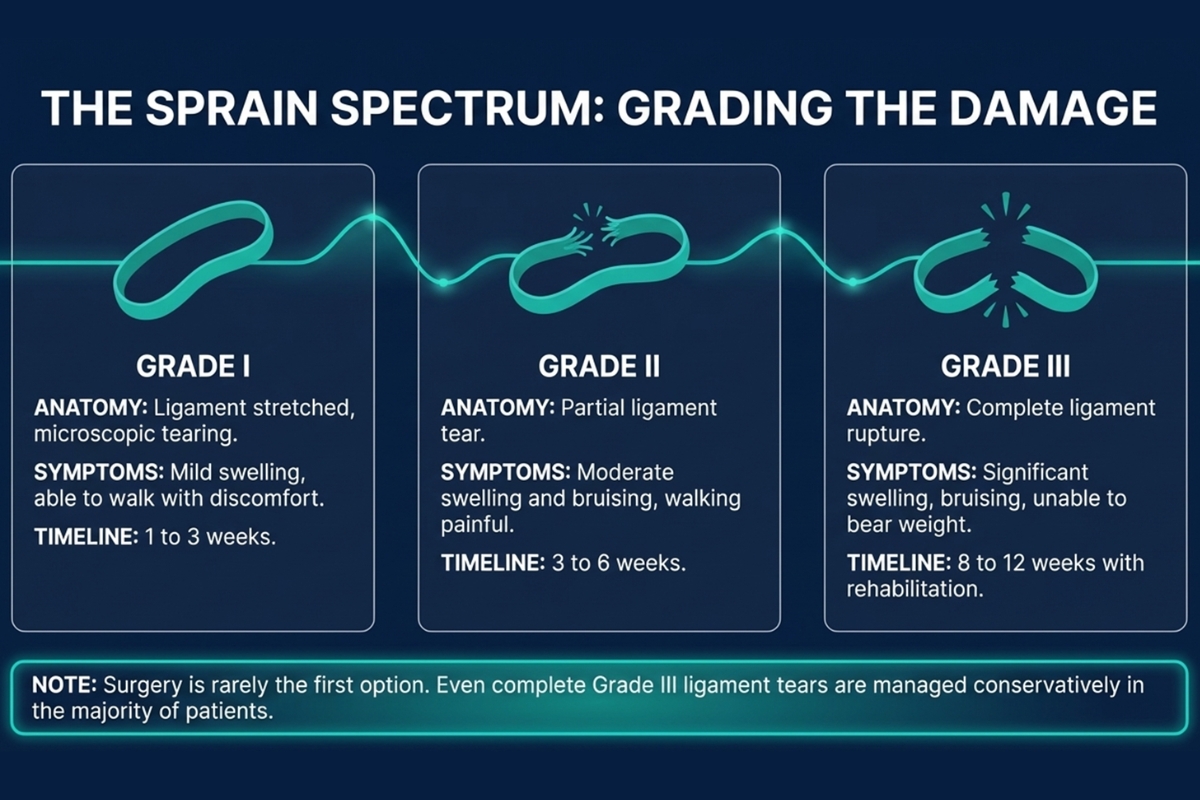
Not all ankle sprains are equal. Doctors classify them into three grades depending on how much the ligament is damaged and how much function is affected.
| Grade | What happened | Typical signs | Recovery |
|---|---|---|---|
| Grade I | Ligament stretched, microscopic tearing | Mild swelling, able to walk with discomfort | 1 to 3 weeks |
| Grade II | Partial ligament tear | Moderate swelling and bruising, walking painful | 3 to 6 weeks |
| Grade III | Complete ligament rupture | Significant swelling, bruising, unable to bear weight | 8 to 12 weeks with rehabilitation |
Grade III sounds alarming, but even a complete ligament tear is managed conservatively in the majority of patients. Surgery is rarely the first option.
Is it a sprain or a fracture? The Ottawa Ankle Rules
This is one of the most common questions after a twisted ankle. The Ottawa Ankle Rules are a clinically validated set of criteria that help determine when an X ray is actually needed. They are not a substitute for examination, but they are a useful guide.
- Bony tenderness along the lower 6 cm of the outer ankle bone or its tip.
- Bony tenderness along the lower 6 cm of the inner ankle bone or its tip.
- Bony tenderness at the base of the fifth metatarsal on the outer side of the midfoot.
- Bony tenderness at the navicular bone on the inner arch.
- Inability to bear weight for four steps, both immediately after the injury and at the time of assessment.
If none of these criteria are present, a fracture is less likely and an X ray may not be necessary. A clinical assessment helps confirm this. If imaging is required, we can guide you to a digital X ray in Thirumullaivoyal.
Typical symptoms to expect
- Immediate pain on the outer side of the ankle at the time of the twist.
- Swelling that may increase over the first 24 to 48 hours. This does not always mean the injury is severe.
- Bruising that may appear over the next day or two, sometimes spreading down toward the foot.
- Difficulty or pain with weight bearing, depending on grade.
- Stiffness and reduced range of ankle movement.
- A feeling of the ankle being unstable or giving way when attempting to walk.
Step by step recovery plan
The modern approach to ankle sprain recovery moves away from complete rest and toward guided, progressive loading. The framework commonly used in sports and musculoskeletal care is called PEACE and LOVE.
Ice and short term pain medicines may still be used selectively for comfort in some patients. The bigger point is that rest alone is usually not enough. A proper rehabilitation plan matters more than passive treatment alone.
What to do week by week
-
Day 1 to 3. Protect and reduce swelling
Elevate the foot, use a compression bandage, and reduce weight bearing if pain is significant. Avoid heat and aggressive massage. Let the ankle settle while preventing unnecessary strain.
-
Day 3 to 7. Begin gentle movement
Start slow ankle circles and gentle range of motion exercises within a pain free range. Attempt gradual weight bearing as tolerated. Swelling should begin to reduce.
-
Week 2 to 3. Strengthening and balance work
Begin calf strengthening, resistance band exercises, and single leg balance. This phase is important for preventing recurrence. Physiotherapy guidance here makes a significant difference. Physiotherapy in Thirumullaivoyal.
-
Week 3 to 6. Functional and sport specific work
Progress to hopping, jogging, lateral movements, and sport specific drills. For cricket and badminton players, this phase simulates game demands before return to play.
-
Return to sport. Gradual and supported
Do not return to full sport until strength and balance are restored on both sides. Ankle bracing during the early weeks back on the cricket field or badminton court can be a reasonable precaution.
Common mistakes that delay recovery
- Ignoring the injury and returning to cricket or badminton after a day or two without rehabilitation.
- Applying heat or doing aggressive massage in the first 48 hours, which can worsen swelling.
- Prolonged complete rest without movement or loading, which can slow recovery.
- Stopping physiotherapy just because pain reduced. Pain settling is not the same as full ligament recovery.
- Wearing loose footwear too early, or walking and playing on uneven ground before balance is restored.
Why rehabilitation matters. Chronic ankle instability
When an ankle sprain is not properly rehabilitated, the ligaments may heal with reduced strength and the ankle’s balance sensing ability, called proprioception, can be impaired. This leads to a pattern of the ankle giving way repeatedly. This is called chronic ankle instability.
Chronic ankle instability is often preventable with a structured physiotherapy programme after the initial sprain. It is one of the main reasons we encourage patients not to treat a twisted ankle as a minor event that only needs a few days of rest.
For weekend cricket players, badminton players, walkers, and people who rely on daily commuting, a guided return to activity plan after an ankle sprain is one of the most practical ways to protect long term function. We build recovery plans around your routine, travel pattern, and physical demands. Read how Dr Sumesh Subramanian approaches treatment decisions.
When to see a doctor promptly
- Complete inability to bear weight after the injury.
- Bony tenderness at the specific points described in the Ottawa Ankle Rules.
- Swelling that is not reducing at all after three to four days.
- Numbness or tingling in the foot or toes.
- Severe bruising extending broadly across the foot.
- A pop or crack heard at the time of injury.
- An ankle that feels completely unstable or collapses with weight.
- Pain that does not improve at all within two to three weeks of conservative care.
What we assess in clinic
A proper ankle examination takes only a few minutes and gives much more information than an X ray alone.
-
Palpation of bony landmarks to assess fracture risk and apply the Ottawa Ankle Rules accurately.
-
Anterior drawer test to check for ATFL laxity and assess the degree of ligament injury.
-
Talar tilt test to assess the CFL and overall lateral stability of the ankle.
-
Range of motion assessment to compare flexibility and detect joint restriction.
-
Weight bearing assessment to grade functional impact and guide the recovery plan.
-
X ray when indicated using Ottawa criteria. We guide you to a digital X ray in Thirumullaivoyal when needed.
Walk ins welcome. Evening slots and Sunday slots available at OrthoCure Bone and Joint Speciality Clinic, Thirumullaivoyal.