The "Biker’s Back": Why Your Commute is Hurting Your Spine (And How to Fix It)
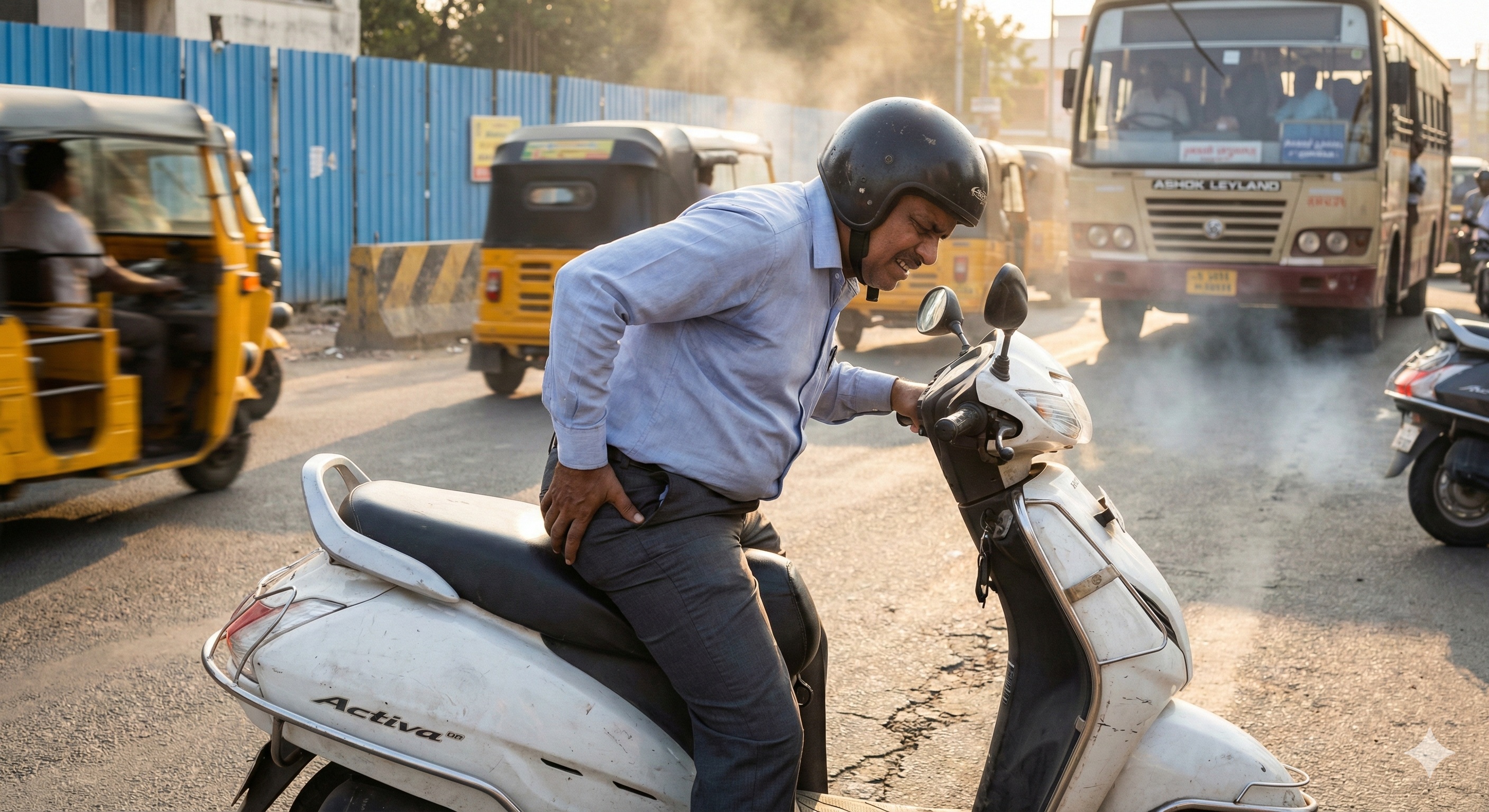
The Reality: It isn't just the potholes. Research suggests that Whole Body Vibration (WBV) combined with a slouched riding posture can significantly increase load on the spinal discs compared to standing.
The Big Question: Is it just stiffness, or a slipped disc?
Why Two-Wheelers Are Hard on Your Back
Whether you are navigating the traffic at the Ambattur Industrial Estate or riding over the concrete patches on the Avadi High Road, your spine is acting as a shock absorber.
When you sit on a bike, especially a scooter where you lean forward, you lose the natural "S-curve" of your spine. Add to this Whole Body Vibration (WBV) from the engine, and your spinal muscles can fatigue rapidly. Over months or years, this may contribute to disc dehydration and stiffness.
The "OrthoCure Checklist": Muscle Catch vs. Disc Issue
How do you know if you need rest or a doctor? Use this guide:
1. It is likely a Muscle Strain (Mechanical Pain) if:
- The pain is a dull ache or stiffness across the lower waist.
- It hurts to stand up straight after getting off the bike, but eases up after walking.
- The pain stays in the back and does not travel below the buttocks.
2. It might be a Disc Issue (Sciatica) if:
- The pain is sharp, burning, or feels like an electric shock.
- The pain travels down one leg (below the knee).
- Red Flag: The pain often worsens when coughing or sneezing.
Quick Self Check in 30 Seconds
Ask yourself these four questions:
- Do you have one-sided leg pain below the knee?
- Is there numbness or tingling in the foot?
- Is there weakness (like your foot slapping the floor when you walk)?
- Does the pain spike when you cough or sneeze?
If you answered YES to any of these, this requires a clinical consultation.
The #1 Mistake: The Wallet in the Back Pocket
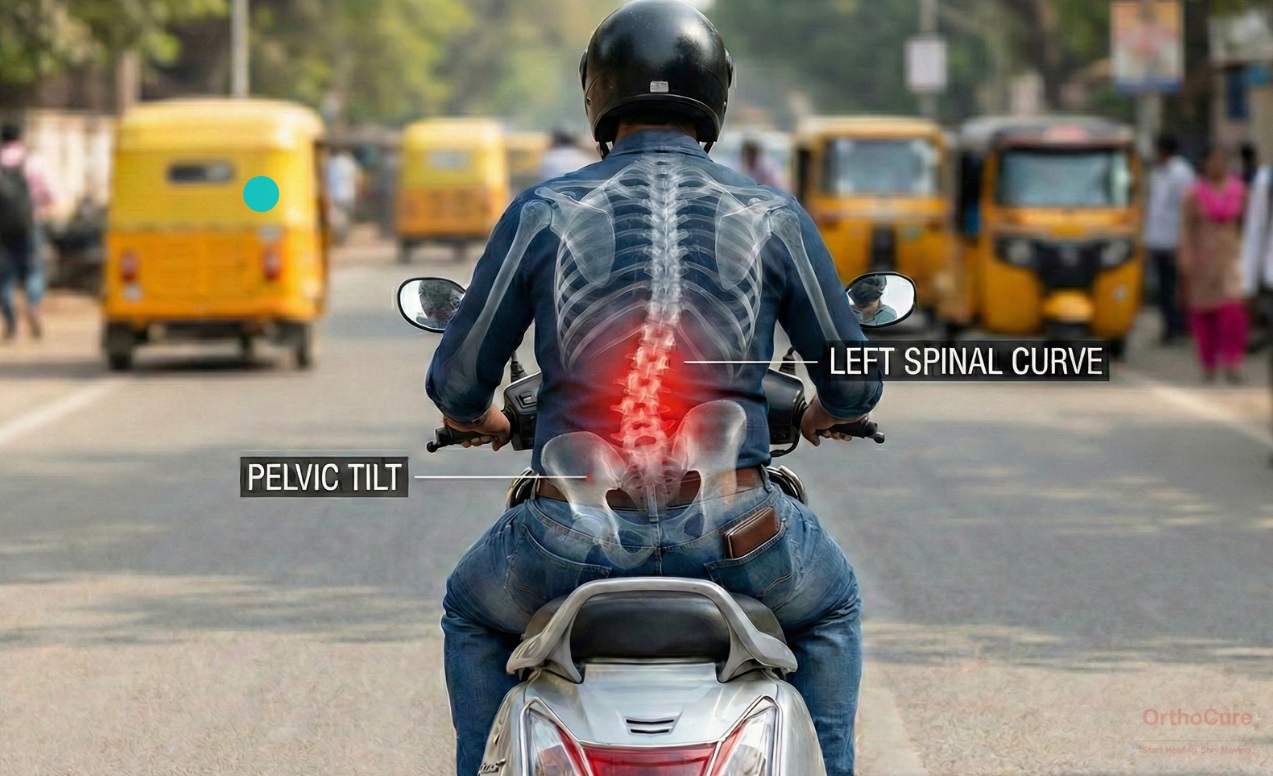
This is a common, easily fixable contributor to back pain I see in men. If you ride with a thick wallet in your back pocket, you are forcing one hip to sit higher than the other.
This tilts your pelvis and forces your spine to curve sideways to keep your head straight. Doing this for an hour every day can strain the lower back and contribute to sciatic type symptoms.
What We Examine in Clinic
Before ordering any scans, we look for physical signs:
- Posture & Alignment: How your spine curves when you stand vs. sit.
- Straight Leg Raise Test: To check for nerve tension (sciatica).
- Neurology: Reflexes and strength in your toes/ankles.
- Sacroiliac Screening: To rule out hip joint issues masking as back pain.
How We Treat Back Pain at OrthoCure Bone & Joint Clinic
Surgery is a tool, not a default. 90% of back pain episodes heal without going under the knife.
Our 3-Step Protocol
- Clear Diagnosis: We use on-site Digital X-ray to check bone alignment and rule out arthritis. We only order MRIs if there are nerve symptoms or "Red Flags."
- Pain Management: Short-term medication to break the spasm cycle—not to mask it, but to allow you to move again.
- Active Rehab: Resting in bed for 10 days actually makes back pain worse. We guide you through "Safe Progression" movements.
When is an MRI needed?
We typically order an MRI only if:
- Pain travels down the leg (Sciatica) and doesn't improve.
- There is weakness or numbness.
- Conservative care (physio/meds) has failed after 4-6 weeks.
- We suspect infection or other non-mechanical issues.
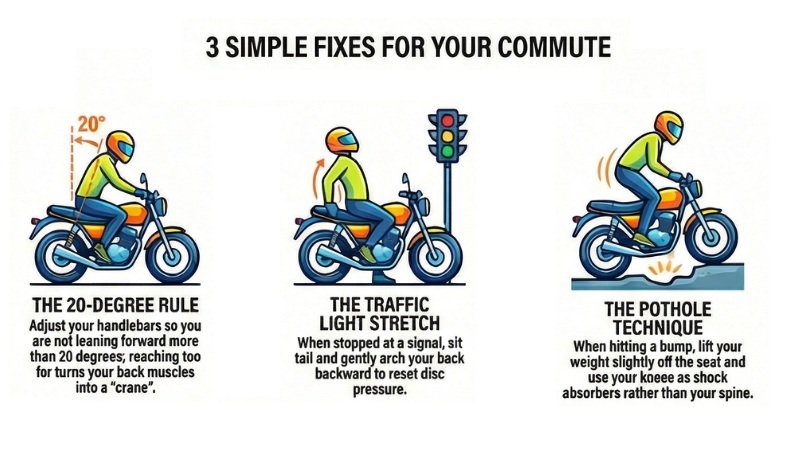
3 Simple Fixes for Your Commute
- Adjust the Handlebar: You should not be leaning forward more than 20 degrees. If you are reaching too far, your back muscles act as a crane all day.
- The Traffic Light Stretch: When stopped at a signal, stand up on your pegs (if safe) or sit very tall and gently arch your back backward.
- Use the Pothole Technique: If you see a bump coming, don’t sit like a sack of potatoes. Press your feet into the pegs and lift your weight slightly off the seat. Let your knees absorb the shock, not your spine.
Back pain affecting your work?
Don't wait for the pain to travel down your leg. Early care prevents chronic damage.
At OrthoCure Bone and Joint Speciality Clinic, Thirumullaivoyal, we focus on conservative recovery first.
Clinic hours: Monday to Saturday 5:00 PM to 9:00 PM. Sunday 11:00 AM to 1:00 PM.
No. 2, 2nd Street, Santhipuram, Thirumullaivoyal, Chennai 600062.