Sitting Rising Test: What Does It Really Tell You About Your Leg Strength?
Getting down to the floor and getting back up looks like a simple movement. But it quietly brings several physical abilities together — leg strength, balance, flexibility, coordination and movement control.
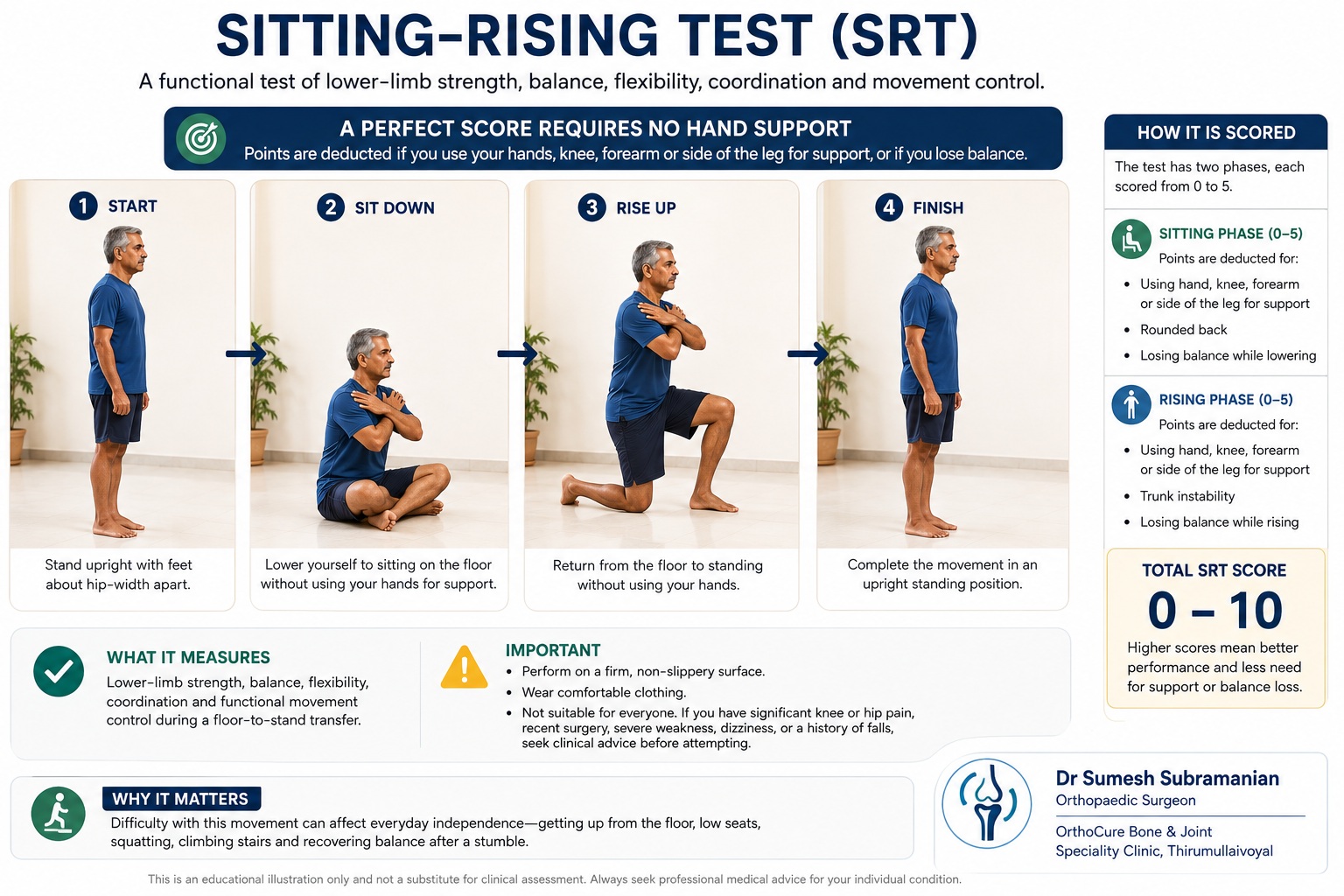
The sitting-rising test is a functional assessment. It can give us information about how several aspects of physical function work together, but it is not a stand-alone test of leg strength and it is not a personal prediction of lifespan.
What is the sitting-rising test?
The Sitting-Rising Test (SRT) is a simple functional assessment in which a person attempts to sit down on the floor and then return to standing while using as little support as possible.
The original SRT scores the sitting and rising phases separately. Each phase can receive a score from 0 to 5, with points deducted when supports such as a hand or knee are used. The two scores are then added to produce a total score from 0 to 10.
How is the Sitting-Rising Test scored?
The sitting and rising phases are scored separately and then combined.
Points can be deducted when support such as a hand or knee is used. The score should be interpreted in the context of the person's age, symptoms and physical ability rather than in isolation.
That makes the test interesting from an orthopaedic perspective because the movement brings together several components of physical function rather than testing isolated quadriceps strength alone.
Why is getting up from the floor such an interesting movement?
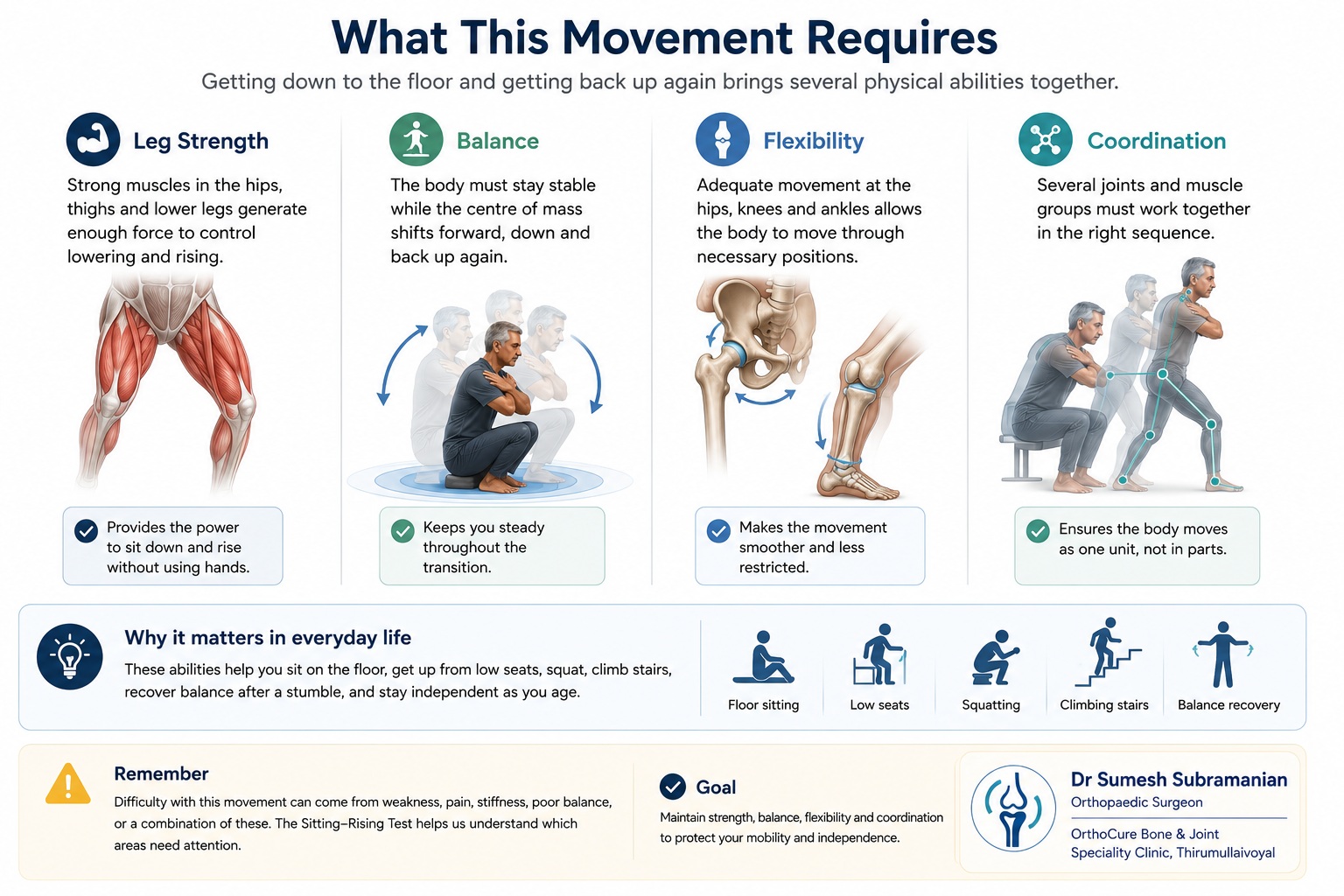
The movement is more demanding than it looks. Getting down and back up depends on several physical systems working together.
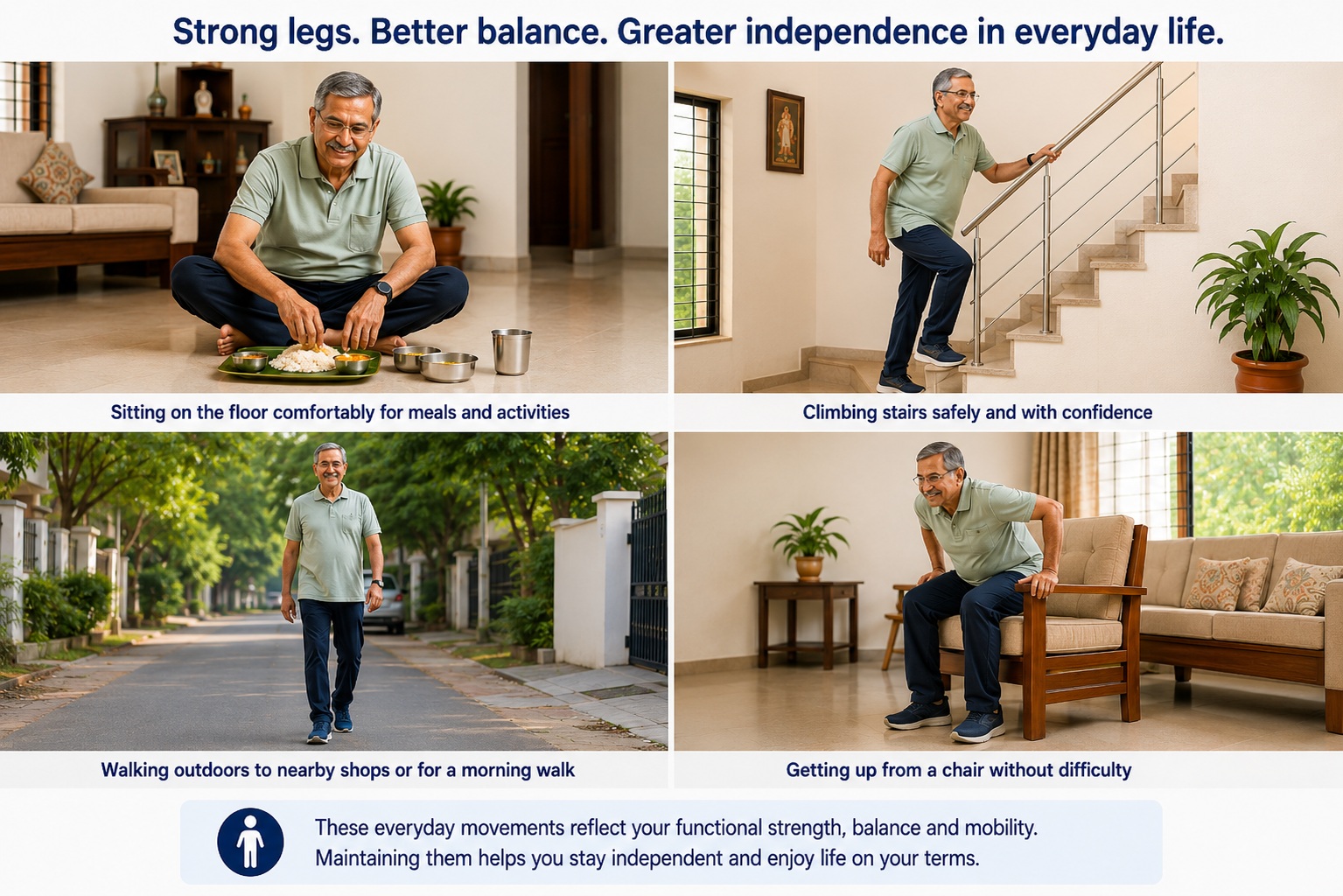
In everyday Indian life, this ability can be surprisingly relevant. Sitting on the floor, getting up from a low seat, using stairs, getting out of a squat, or getting up after sitting on the floor all require coordinated lower-limb function.
For an older adult, difficulty with these movements may affect something much more important than a test score: independence.
Leg strength
The hips, thighs and lower-leg muscles have to generate enough force to control both lowering and rising.
Balance
The body has to remain controlled while the centre of mass moves substantially during the transition.
Flexibility
Adequate movement at the hips, knees and ankles helps make the transition easier.
Coordination
Several joints and muscle groups have to work together rather than independently.
What did the research actually find?
One of the best-known studies of the sitting-rising test followed 2,002 adults aged 51–80 years. Participants performed the floor sitting-rising test and were followed for a median of approximately 6.3 years.
The researchers found that lower SRT scores were associated with higher all-cause mortality during follow-up. After adjustment for age, sex and body mass index, the lowest scoring group had substantially higher mortality risk than the highest scoring group.
The study showed an association, not proof that a poor sitting-rising score causes early death. A person's score can be influenced by age, muscle strength, balance, flexibility, body composition, joint problems and other health factors.
So this is better understood as a marker of functional capacity than as a personal "longevity test."
What does a low score potentially tell us?
A lower performance may indicate that one or more components of physical function deserve attention.
- Reduced lower-limb strength
- Reduced balance or postural control
- Reduced flexibility
- Difficulty coordinating complex movements
- Pain or stiffness affecting movement
- Reduced confidence with floor transfers
The useful question is therefore not simply "What score did I get?" but rather: "Why is this movement difficult for me?"
How is the sitting-rising test different from a chair-rise test?
These tests assess related aspects of functional mobility, but they use different movements and answer slightly different clinical questions.
| Test | Basic movement | What it broadly assesses |
|---|---|---|
| Sitting-Rising Test Floor transfer | Floor → sitting → floor → standing | Strength, balance, flexibility, coordination and functional movement control. |
| 5-Times Sit-to-Stand Chair transfer | Chair → standing → sitting, repeated five times | Functional lower-limb strength, power and transfer performance. |
| 30-Second Chair Stand Chair transfer | Repeated chair rises for 30 seconds | Functional lower-body strength and endurance. |
These tests answer related but different questions. A clinician may choose one depending on the person's age, symptoms, mobility and the purpose of the assessment.
What can make getting up from the floor difficult?
There is rarely one single explanation. The movement can become difficult because of pain, weakness, stiffness, balance problems, reduced confidence or a combination of these factors.
Pain
Knee, hip or back pain can make both lowering to the floor and getting back up more difficult.
Reduced strength
Reduced strength around the thighs, hips or lower legs can limit the ability to generate enough force to rise.
Stiffness
Reduced movement at the hips, knees or ankles can make the transition mechanically more difficult.
Balance or confidence
Poor balance or fear of falling may cause someone to avoid or restrict the movement even when strength is adequate.
Knee arthritis, hip stiffness, reduced quadriceps or hip strength, poor balance, reduced ankle mobility, fear of falling and general deconditioning can all affect this movement.
This is why a functional test should be interpreted alongside the person's history and examination rather than in isolation.
Watch the sitting-rising test explained
Want to see the movement and understand what it may tell us about leg strength, balance and functional mobility? I explain the test and the research in this short video.
5-minute video: Sitting Rising Test, leg strength and functional mobility — Dr Sumesh Subramanian.
Watch on YouTubeShould you try the test at home?
Be sensible here. The floor test is not appropriate for everyone. Someone with significant knee or hip pain, recent surgery, severe weakness, dizziness, balance problems or a history of falls may not be a good candidate for attempting it without supervision.
A few situations need extra caution
The floor test should not become a challenge that someone feels they have to complete at any cost.
- Significant knee or hip pain
- Recent surgery or injury
- Severe weakness
- Dizziness or balance problems
- Previous falls
- Difficulty getting safely down to the floor
If any of these apply, it is safer to discuss your mobility with a clinician or physiotherapist rather than forcing the movement simply to obtain a score.
When should difficulty getting up be assessed?
Consider an orthopaedic or medical assessment if difficulty with getting up is new, progressively worsening, or accompanied by:
- Persistent knee, hip or back pain
- Repeated falls or near-falls
- New weakness in one or both legs
- Difficulty climbing stairs
- Increasing difficulty getting up from a chair
- Walking becoming noticeably slower or less confident
- Loss of independence in everyday activities
The assessment should focus on the person rather than the score alone. We can then decide whether strengthening, physiotherapy, treatment of a painful joint, balance work or another approach is appropriate.
What can help if mobility is reduced?
The answer depends on why the movement is difficult. When weakness, balance or mobility is the main limitation, structured rehabilitation may be useful.
Build strength
Targeted strengthening, particularly of the quadriceps and hips.
Practice useful movements
Train functional transfers and floor-to-stand sequences safely.
Work on balance and mobility
Balance retraining and mobility exercises for the ankles and hips.
Address the reason for limitation
Treat pain, stiffness or other medical issues contributing to functional limitation.
If reduced strength, balance or mobility is the main limitation, structured rehabilitation may help us work on movement control, strength and functional recovery.
At OrthoCure Bone & Joint Speciality Clinic, Thirumullaivoyal , physiotherapy can be coordinated with the orthopaedic assessment when appropriate.
Learn more about physiotherapy at OrthoCure →Related reading from Dr Sumesh Subramanian
When should you get your mobility assessed?
If you notice new difficulty getting down to or up from the floor, or if walking, stairs or everyday transfers are becoming harder, it is reasonable to discuss the problem with a clinician.
Dr Sumesh Subramanian
Orthopaedic Surgeon
OrthoCure Bone & Joint Speciality Clinic, Thirumullaivoyal
Frequently asked questions
What is the sitting-rising test?
The sitting-rising test is a functional assessment in which a person sits down on the floor and rises back to standing, using as little support as possible. The original SRT is scored from 0 to 10.
What does the sitting-rising test measure?
It reflects several aspects of physical function, including lower-limb strength, balance, flexibility, coordination and the ability to control movement during a floor transfer.
Is the sitting-rising test the same as a chair-rise test?
No. The floor sitting-rising test and chair-rise tests assess related aspects of functional mobility but are different assessments with different protocols.
Does a poor sitting-rising test mean that someone will die early?
No. Research has found an association between lower test performance and higher mortality risk in certain populations. The test should not be interpreted as a prediction that an individual will die early.
What should I do if I find it difficult to get up from the floor?
Difficulty may reflect reduced strength, balance, flexibility, joint pain or other functional limitations. If the difficulty is new, worsening, associated with pain, weakness, falls or loss of independence, assessment may be appropriate.