- Weight gain increases the mechanical force through the knee joint during walking, stair climbing, and getting up from sitting
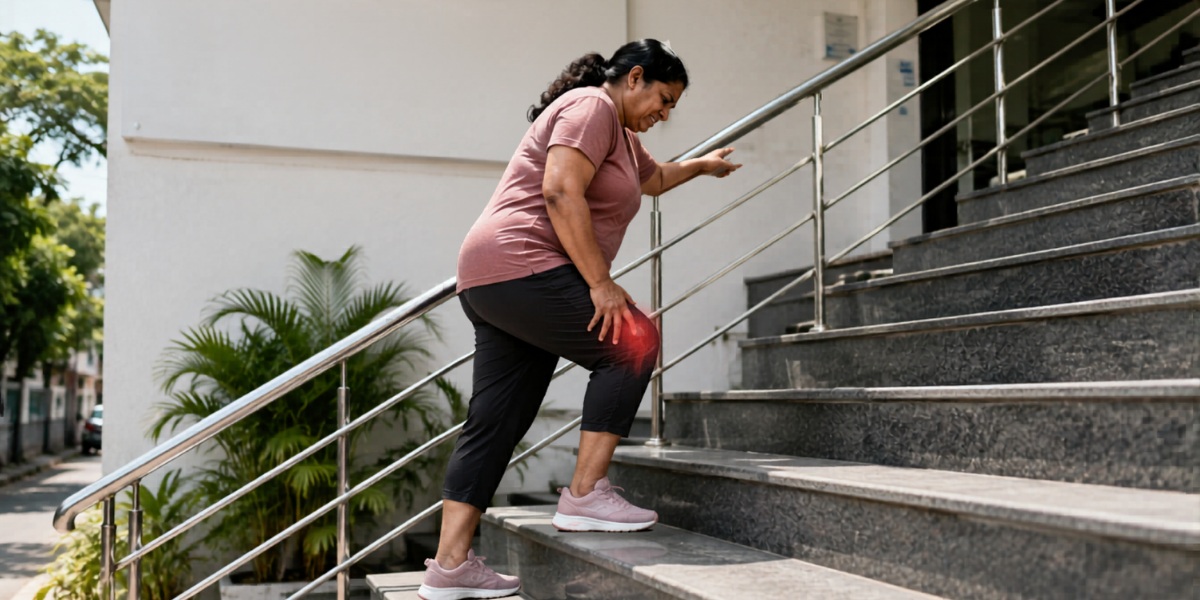
- Stairs and the first few steps after rest are typically the earliest painful activities — this is explained by the biomechanics of load at knee flexion
- Early weight-related knee pain is often manageable without surgery — conservative management is the standard starting point
- Weight reduction of around 10 percent of body weight and quadriceps strengthening are the two most evidence-based non-surgical approaches
- Sudden swelling, locking, instability, or pain at rest are signs that warrant proper examination rather than self-management
What Is Actually Happening in the Knee
The knee is a weight-bearing joint. Every kilogram of body weight translates into a proportionally larger force through the joint with each step. But the relationship is not one-to-one. The forces that travel through the knee are significantly amplified depending on what you are doing.
These figures come from in vivo instrumented implant studies that have directly measured tibio-femoral contact forces during daily activities. The practical implication is significant. Research published in Arthritis and Rheumatism found that each pound of weight lost results in approximately a four-fold reduction in the accumulated load on the knee per step during daily activities. Across thousands of steps per day, this adds up to a substantial difference in what the joint is managing.
Many patients describe it clearly without realising the mechanics: "My knees feel fine once I start moving, but the first few steps after sitting are the worst part of my day." That pattern of pain on initiation that settles with movement is one of the earliest and most consistent signs of load-related knee strain.
Stairs often reveal knee trouble before walking on flat ground causes much difficulty. This is not random. It reflects exactly how differently the forces are distributed depending on the activity. When a patient tells me stairs hurt but walking is still manageable, the first thing I think about is load management, not necessarily advanced disease.
Why Stairs Are Usually the First Warning
Flat walking distributes load across the knee at a relatively lower angle of bend. Climbing stairs is different. The knee must bear significant load while also bending to 60 to 90 degrees. This demands more from the cartilage, the surrounding muscles, and the joint structures simultaneously.
The sequence in which activities become difficult often follows a predictable pattern as load increases:
- Stairs, especially climbing up or the first step down
- Getting up from a low chair, floor, or Indian-style sitting
- Standing after prolonged sitting: in the car, at an office chair, or after temple sitting
- Walking longer distances or on uneven ground
- Squatting for household tasks, prayer positions, or floor work
- Morning stiffness that takes time to settle after getting up — an early sign also discussed in early arthritis recognition
Most patients who come with these complaints have been managing the discomfort for months, assuming it will resolve on its own or worrying it must indicate something serious. Neither is usually correct.
Other Daily Life Patterns That Add Up
In clinic, I find that the real picture only becomes clear when you ask about someone's actual day. Not just whether the knees hurt, but what getting through a typical day actually involves.
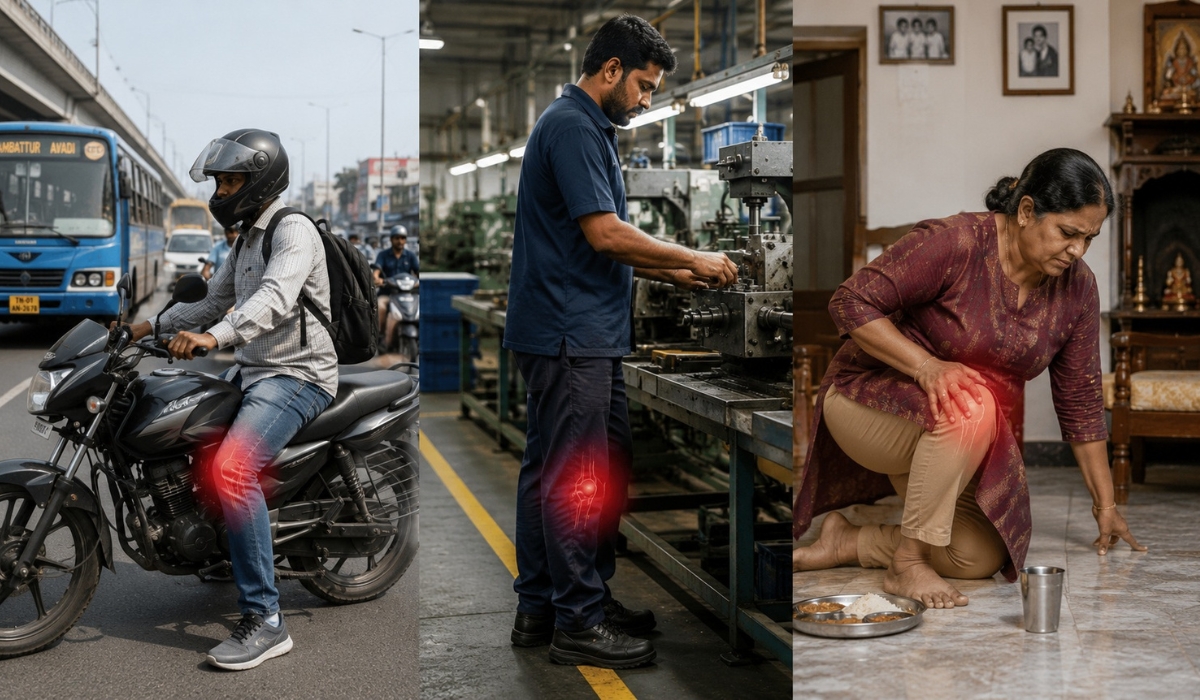
Two-wheeler commuting
At OrthoCure Bone and Joint Speciality Clinic, Thirumullaivoyal, this is one of the most common patterns we see among working adults in the Ambattur and Avadi belt. Getting on and off a two-wheeler requires the knee to bend under load repeatedly. For someone commuting 45 minutes each way through Chennai traffic, this adds dozens of significant loading events on top of the baseline stress of walking and stair use. The stop-start nature of city riding means the knee rarely gets sustained rest during the commute.
Long standing work and factory shifts
Standing for extended periods is not neutral for the knee. The joint manages load continuously. For workers in the Ambattur industrial belt who stand through eight-hour shifts, the combined effect of sustained loading plus weight gain significantly increases cumulative stress. By evening, knee swelling and stiffness are common complaints that tend to be dismissed as "tiredness."
Cinema halls, bus journeys, and long travel
Sitting in a fixed position for 2 to 3 hours, whether in a cinema hall, a long bus ride, or a train journey, and then getting up is a particular trigger. The knee joint stiffens during prolonged sitting, and the moment of standing from a low seat with added body weight becomes one of the sharpest pain points patients describe. Many people avoid window seats on long travel specifically because of this.
Temple stairs and festival standing
Many temples in the region involve climbing multiple flights of steps. For someone already managing weight-related knee strain, the combination of stair climbing plus outdoor heat plus sustained standing during festivals or family events brings out symptoms that were only mild during regular daily activity.
Indian toilet use and floor-level squatting
Indian squat-style toilet positions require near full knee bend under load. It is one of the highest demand positions for the joint. Many patients do not mention this spontaneously, but when asked directly, they confirm it is often the most painful and most avoided part of their daily routine. This is a practical and important detail for planning activity modification.
Morning stiffness
A common early sign is stiffness that takes several minutes to settle after getting up. This often represents the joint responding to a period of inactivity. The fluid shifts, muscles stiffen slightly, and the joint needs movement to lubricate properly. In early weight-related knee strain, this pattern is typical and manageable. When it extends beyond 30 minutes consistently, it warrants proper evaluation.
Morning stiffness that settles with a few minutes of movement is common and often not serious. Morning stiffness that persists for 30 minutes or more, or is accompanied by swelling and warmth, suggests a different process that should be examined properly.
Floor sitting and getting up
Prayer positions, floor meals, sitting to watch TV, or working at floor level. All of these require moving from floor to standing repeatedly. Each transition involves near-maximum knee bend under load. For someone already managing weight-related knee strain, getting up from the floor is often described as the single most difficult moment of the day.
What Actually Helps: Conservative First
The good news is that weight-related knee pain, especially when caught early, responds well to conservative management. Surgery is rarely the starting point here.
Structured weight reduction
Research is fairly consistent that a weight reduction of around 10 percent of body weight produces clinically meaningful improvements in both pain and daily function. More modest losses of around 5 percent may improve functional disability to some degree, but are less reliable for pain reduction specifically. This is not about reaching a number on a scale. It is about reducing the mechanical load the joint manages each day. Sustainable dietary change and a gradual increase in safe physical activity is the approach that holds up. Crash diets and dramatic exercise programmes typically do not work long term and often result in regaining the lost weight.
Muscle Strengthening: The Quadriceps
The muscles around the knee, primarily the quadriceps at the front of the thigh, act as shock absorbers. Stronger muscles reduce the direct load the joint cartilage must manage. Multiple systematic reviews confirm that quadriceps strengthening is an effective, well-evidenced intervention for reducing pain and improving function in this pattern of knee pain. It is most effective when combined with weight management rather than as a standalone approach.
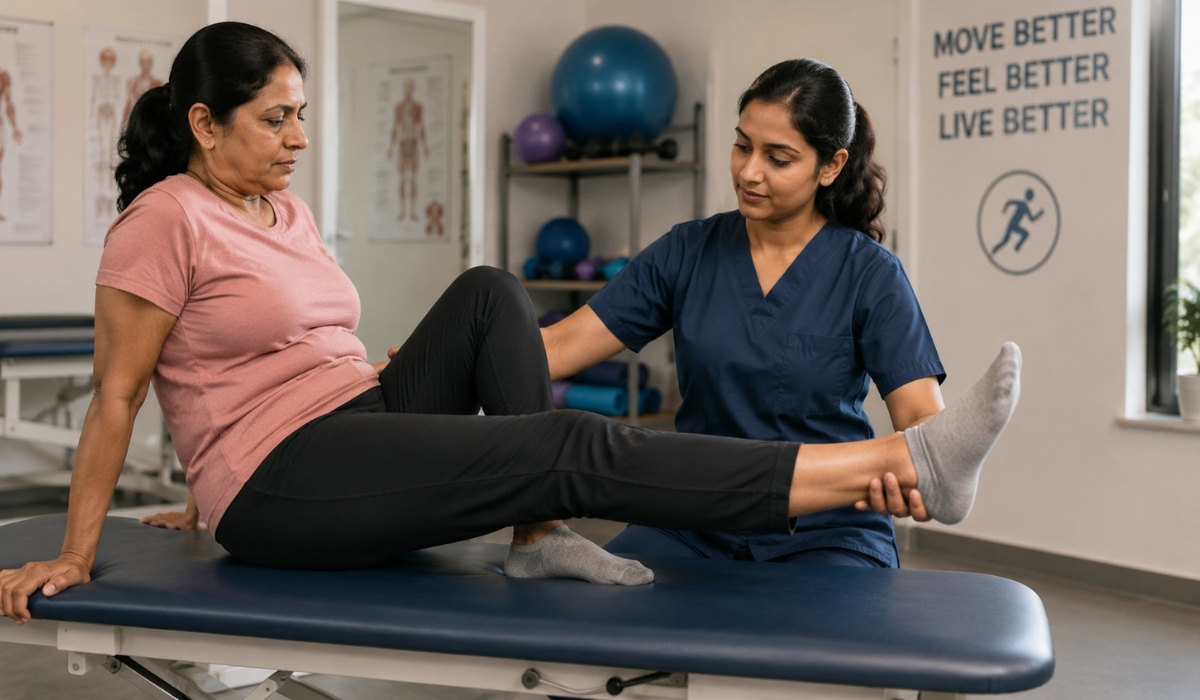
I commonly see patients who have completely stopped walking because their knees hurt. This is usually counterproductive. Inactivity weakens the quadriceps, which then makes the knee pain worse over time. The goal is controlled, pain-managed movement rather than avoidance. We work on what kind of walking, for how long, and at what pace is appropriate. There is good evidence that walking, done appropriately, helps rather than harms the joint over time.
Activity Modification, Not Complete Rest
Certain activities need to be temporarily reduced or modified. But complete rest is rarely the answer. For most patients, the programme involves:
- Reducing stair use temporarily where possible, not eliminating movement
- Using a chair instead of floor-level sitting during high-volume periods
- Short, comfortable walking: daily, not occasional
- Avoiding activities that load the knee at deep bend angles until muscle support improves
Footwear and support
Appropriate footwear significantly affects knee loading. Flat hard soles offer minimal shock absorption. Supportive cushioned footwear, particularly for long-standing work or daily walking, reduces the impact force the knee must absorb with each step. A separate article covers how footwear choices affect knee joint loading in more detail.
What not to do
Painkillers alone are not management. They reduce the symptom without addressing the underlying load problem. Self-prescribed injections and "knee caps" from medical shops, used without examination, often delay appropriate management without improving the underlying cause.
When to Get It Examined
Not every knee pain in this pattern requires urgent medical attention. But certain presentations should be assessed rather than managed at home:
- Pain is limiting daily activities like stairs, sitting to standing, or basic walks
- Swelling in or around the knee joint, especially if persistent
- Feeling of instability or knee "giving way"
- Pain at rest or at night that does not settle
- Morning stiffness lasting more than 30 minutes consistently
- No improvement after 4 to 6 weeks of reasonable activity modification
- Pain that is worsening rather than staying stable
An in-person examination, and sometimes a standing X-ray, can clarify whether there is early arthritis, whether cartilage changes are significant, and what the appropriate management plan should be. Scans do not replace examination, and scan findings alone do not determine whether surgery is needed. That is always a clinical decision based on the full picture.
If you have been told surgery is needed for weight-related knee pain without a trial of structured conservative management, a second opinion is reasonable. In most cases, especially when arthritis is early or moderate, non-surgical management should be attempted first.
When Knee Pain May Not Be Purely Mechanical
This article focuses on weight-related mechanical knee pain, which is the most common pattern in this catchment area. But not every knee pain that happens to coincide with weight gain is purely mechanical. It is worth being aware of the following:
- Sudden swelling, particularly after a specific movement or minor incident, may suggest a meniscus injury or ligament problem rather than simple overload
- Locking or catching (the knee momentarily refusing to straighten fully) points toward a structural problem, not weight alone
- Warmth, redness, and significant swelling at rest, especially if both joints are affected, can indicate inflammatory arthritis, which behaves differently and needs different management
- Instability or the knee giving way suggests possible ligament involvement regardless of weight
- Pain disproportionate to weight or activity level, or pain that continues at rest and at night, is a signal to get it properly examined rather than manage independently
The reason this matters: if the problem is inflammatory arthritis, ligament damage, or a significant meniscus tear, the management approach is different from simple load-related strain. Weight reduction and quadriceps strengthening are useful in many knee conditions, but the correct diagnosis changes the priority and sequence of treatment. An examination, and sometimes an X-ray, is the only reliable way to clarify this.
Common Questions
If this pattern sounds familiar
If stairs, getting up from sitting, or floor transitions are becoming noticeably more difficult, and simple activity changes have not helped, a proper evaluation can clarify what is happening and give you a practical plan. Conservative management is almost always the starting point.
WhatsApp Dr. Sumesh to Enquire- Messier SP et al. Weight loss reduces knee-joint loads in overweight and obese older adults with knee osteoarthritis. Arthritis & Rheumatism, 2005. — Source for the four-fold load reduction per pound lost finding.
- Bergmann G et al. Loading of the knee joint during activities of daily living measured in vivo in five subjects. Journal of Biomechanics, 2010. — In vivo contact force data for walking, stairs, and sit-to-stand activities.
- Messier SP et al. Effects of intensive diet and exercise on knee joint loads, inflammation, and clinical outcomes (IDEA trial). JAMA, 2013. — Landmark RCT on weight reduction and knee pain outcomes.
- Christensen R et al. Effect of weight reduction in obese patients diagnosed with knee osteoarthritis: a systematic review and meta-analysis. Annals of the Rheumatic Diseases, 2007. — Meta-analysis establishing 5% and 10% weight loss thresholds for functional and pain outcomes.