Watch: The right pillow for your neck
If you wake up with neck pain, stiffness, or a dull headache, it does not automatically mean a disc problem. In many patients, the reason is simply pillow height and sleep alignment.
We see this commonly in Thirumullaivoyal, Ambattur, and Avadi because daytime neck load is already high. Two wheeler travel on uneven roads, long screen time, and late night phone use keep neck muscles tight. A wrong pillow then holds the neck in a strained position for six to eight hours.
The good news. Most pillow related neck pain improves with alignment correction and a few daily habits. Medicines and scans are not the first step for most people.
Why pillow height matters?
Your pillow is not meant to support only the head. It is meant to support the neck and keep the spine in a neutral line while you sleep.
- Too low. The neck bends sideways or drops forward. Muscles stay active through the night.
- Too high. The neck tilts upward. Joints get compressed. Morning pain and headache are common.
Research studies and muscle activity work show that height and support change symptoms and sleep comfort, especially when the neck stays neutral.
Side and back - What happens to your neck?
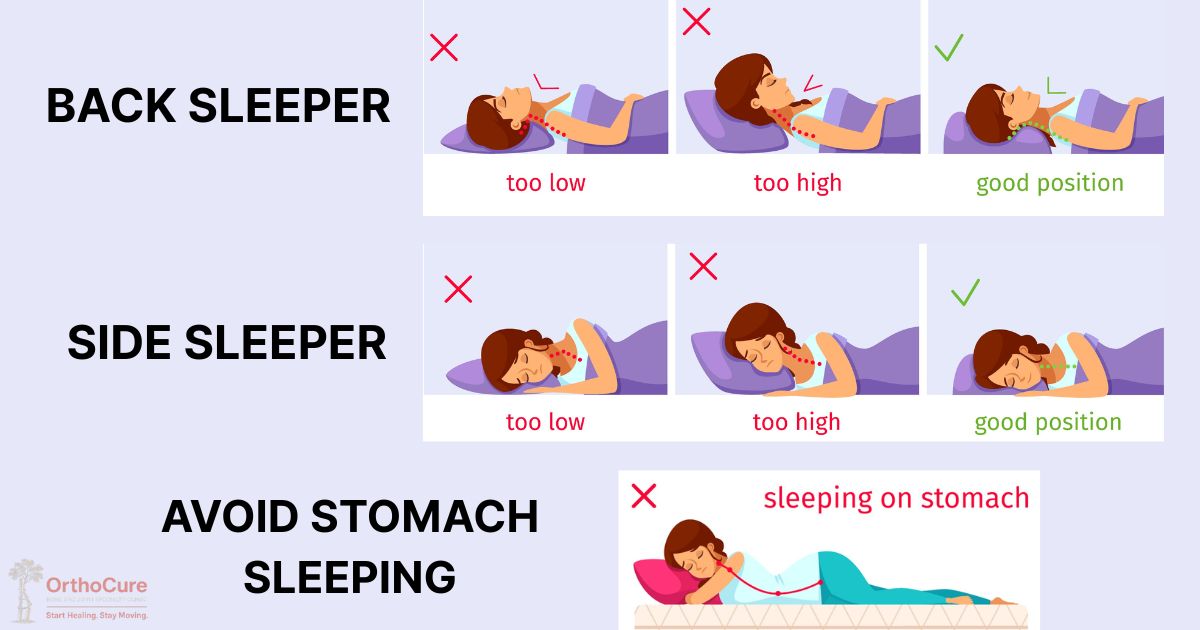
Side sleeping
- The pillow must fill the gap from ear to outer shoulder so your nose and chest stay aligned.
- If the pillow is thin, the head drops. If it is thick, the neck bends upward.
- Shoulder width matters. Broad shoulders usually need a little more height.
Back sleeping
- Low or medium low height works best.
- A gentle neck roll supports the natural curve.
- Avoid a pillow that pushes the chin toward the chest.
How to choose the right pillow: Height and comfort
One: Choose height first
- Side - Medium height that fills shoulder width. Adjustable loft is helpful.
- Back - Low or medium low height with gentle neck support.
- Stomach - Thinnest possible, or no pillow.
Two: Choose material that suits Chennai humidity
- Latex and open cell memory foam tend to breathe better.
- Use a breathable cover and air the pillow regularly.
- Comfort matters, but height must still match your sleep position.
Three: Quick alignment check at home
- Side view - Chin should not tuck down or tilt up.
- Front view while side sleeping - Nose and sternum should line up.
- Feel test - If you keep adjusting the pillow at night, change height by one to two cm.
Seven nights - Pillow fit test
- Nights 1 to 2: Start with your best guess height for your position.
- Nights 3 to 4: If you wake sore, adjust loft by one to two cm.
- Nights 5 to 7: Keep the height where you stop waking to fix the pillow.
This simple height titration approach often reduces morning neck symptoms within a week.
Three daily levers that reduce neck pain recurrence
- Move: Walk, cycle, or light exercise for thirty to forty five minutes most days. Break desk time every hour.
- Load: Keep screens at eye level. Avoid long phone bending. Keep bags light.
- Sleep: Aim for seven to eight hours. Keep the room cool. Air the pillow during humid months.
Related reading: Tech neck, PEACE and LOVE for acute injuries, Cracking knuckles, Early arthritis signs, All blog posts.
When to see a doctor now
- Pain lasting more than two to three weeks
- Arm pain, tingling, numbness, or weakness
- Severe night pain or pain that wakes you repeatedly
- Fever, recent trauma, or past cancer history
Care is individual if you have cervical spondylosis, radiculopathy, migraine, osteoporosis, diabetes, pregnancy, or sleep apnea.

Dr Sumesh Subramanian
Orthopaedic Surgeon at OrthoCure Bone and Joint Speciality Clinic, Thirumullaivoyal, Chennai. Focus on practical neck, shoulder, and spine care with conservative first management.
Still waking with neck pain
Get a quick sleep posture check and pillow fit guidance from a spine aware orthopaedic clinic.
Book at OrthoCure ThirumullaivoyalOpen all days. Mon to Sat 5 pm to 9 pm. Sunday 11 am to 1 pm.
Find the clinic on Google Maps. See our map and directions.
References. Selected
- Chun Yiu JP, et al. The effects of pillow designs on neck pain waking symptoms and spinal alignment. Systematic review and meta analysis. 2021. PubMed
- Sacco ICN, et al. The effect of pillow height on muscle activity of the neck. EMG study. 2015. PubMed
- Jiao R, et al. The impact of pillow height on neck muscle activity. Pilot EMG. 2024. PubMed
- Cary D, et al. Sleep posture and non specific spinal symptoms. Review. 2019. PMC
- Yamada S, et al. Change in neck pain after strict pillow height adjustment. 2023 clinical study. PMC
- Erfanian P, et al. Semi customized cervical pillow vs conventional. Trial. 2004. PMC
This guide is educational and not a substitute for personal care.
Illustration credit when required. Adapted from macrovector / Freepik, modified for educational use by OrthoCure Bone and Joint Speciality Clinic Thirumullaivoyal Chennai.